#rankmath
Title: Polo Shirt Collar Curling: Manufacturing Controls
Description: Learn how collar construction, knit balance, fusing, plackets, pressing and wash approval affect polo shirt collar curling in bulk production.
Keyword: polo shirt collar curling
#rankmath
Polo Shirt Collar Curling: Fabric, Fusing, Knitting and Wash-Approval Controls
Polo shirt collar curling is rarely a one-step sewing problem. It usually develops when several parts of the garment work against each other: the collar knit lacks recovery or balance, the collar stand is poorly supported, the placket pulls the neckline off shape, pressing sets an unwanted roll, or laundering exposes instability that was not checked during sampling.
For fashion brands, streetwear labels, and wholesale buyers, the practical question is not simply whether a development sample looks flat on a hanger. The question is whether the collar retains its intended shape after the care process and during ordinary wear. That requires a construction review before bulk production, not a last-minute finishing correction.
A sourcing partner should be able to discuss fabric behavior, collar architecture, sample handling, and approval criteria in the same conversation. JUNSHEEN supports custom apparel development from sampling through bulk production, including polo programs and private-label trims. Buyers developing a new program can also review its Custom Polo Shirts Manufacturer page for product-development context.
What collar curling looks like in a polo shirt

“Curling” can describe several different failures, and identifying the pattern matters before changing materials or construction.
- Edge roll: the outer collar edge turns upward or inward.
- Leaf curl: the visible collar leaf twists, cups, or will not lie evenly on the chest.
- Stand collapse: the collar loses support at the neckline and folds irregularly.
- Asymmetric curl: one point or side rolls more than the other.
- Placket-driven distortion: the collar appears sound when open but pulls or twists when the placket is buttoned.
- Post-wash change: the collar is acceptable before laundering but curls after the agreed care process.
These symptoms can overlap. A collar that rolls only after washing, for example, may reflect knit shrinkage or differential movement between components. A collar that is uneven directly after sewing may point instead to cutting direction, collar joining, seam tension, or pressing.
Start with collar construction, not a cosmetic fix

A polo collar commonly combines a collar leaf, a collar stand or neckline seam area, seam allowances, a placket, and sometimes reinforcement or fusing. Each element affects how the collar sits.
The leaf is the visible portion that folds outward. It needs enough body to hold its shape without becoming stiff or uncomfortable. The neckline area must distribute the collar evenly around the neck opening. If the collar length and neckline length are not matched correctly, sewing can introduce either excess fullness or stretch. Both can create a curl that pressing may temporarily hide.
The placket also deserves separate attention. It adds layers, stitching lines, buttons, and sometimes interfacing near the center front. If it is heavier, more rigid, or more stable than the adjacent collar and body fabric, it can pull the collar toward the front opening. Conversely, a soft placket beside a firm collar can allow the neckline to lose structure.
For development, specify the intended wearing position: collar open, partially buttoned, or fully buttoned. A fashion polo with a relaxed, open neckline may accept a softer shape than a uniform-style polo intended to look crisp throughout the day. Those are product decisions, not universal pass/fail rules.
Knit balance and yarn selection affect recovery
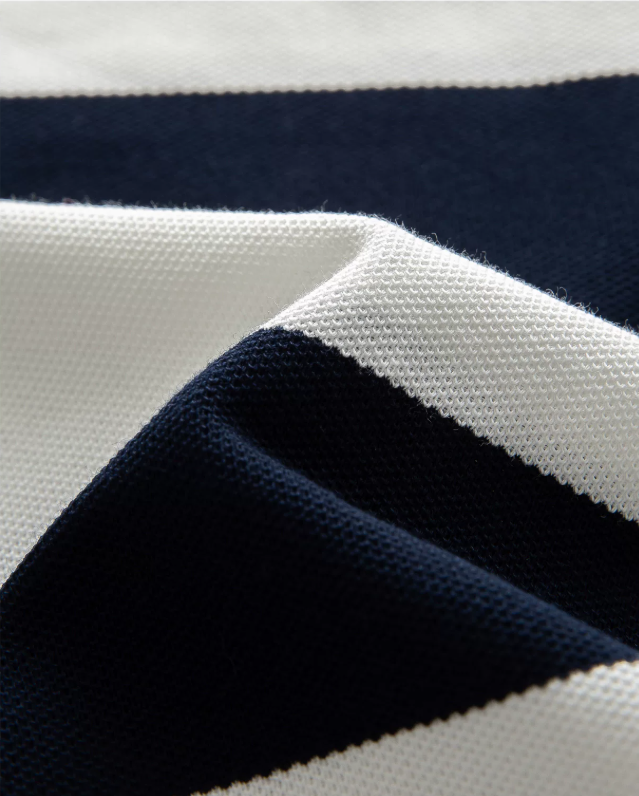
Many polo collars are made from rib or another engineered knit rather than the body fabric. That is useful because the collar can have different stretch, recovery, and visual texture from the body. It also creates a compatibility issue: the collar and body can react differently to cutting, sewing, heat, moisture, and laundering.
A balanced collar knit is less likely to show a persistent directional roll than a knit whose face and back behave very differently. The development team should review whether the knit has a natural tendency to curl at a cut edge, whether it recovers after extension, and whether its wale and course direction are correctly oriented in the pattern.
Yarn choice and knit construction influence hand feel, resilience, density, and the way the collar returns after being folded. A very soft collar may suit a casual garment but need a construction adjustment to avoid looking limp. A firmer collar may support a cleaner silhouette but can feel restrictive or clash with a soft jersey body. The target is compatibility with the intended garment, not maximum stiffness.
Ask the factory to retain the approved collar knit reference and identify it clearly in the production file. Substituting a visually similar rib without reviewing recovery and hand feel can change the finished collar behavior.
Check the relationship between collar and body fabric
A collar should be evaluated with the actual body fabric, not in isolation. The body fabric’s stretch, weight, wash behavior, and neckline stability all affect the seam joining the collar.
Useful development questions include:
- Does the body neckline stretch noticeably during handling or sewing?
- Is the collar knit being cut in the correct direction for the approved appearance?
- Does the collar have compatible stretch with the neck opening?
- Is the intended body fabric soft enough that a very rigid collar will look disconnected?
- Will garment dyeing, washing, brushing, or another finish change the balance between body and collar?
For a custom program, record the body fabric and collar material as separate approved components. “Polo fabric” is not sufficiently specific for bulk control.
Fusing should support the design without creating a hard hinge

Interfacing or fusing can stabilize areas around the placket and collar, but it should be treated as part of the construction system. It is not an automatic remedy for curling.
A fused area that is too firm relative to the collar knit can form a visible hinge. The collar may bend sharply at the fused boundary or pull toward the placket. A fuse that is too light may not provide the intended support. Inconsistent bonding can create irregular shape after laundering or pressing.
During sampling, buyers should ask where any fuse is applied, what visual purpose it serves, and whether the sample has been inspected after the agreed wash process. This does not require prescribing a particular fuse for every polo. It requires confirming that the selected support material works with the actual collar, placket, and body fabric.
If the design calls for a soft vintage or washed appearance, avoid assuming that a crisp, heavily supported collar is compatible with the brief. If the design needs a cleaner retail presentation, define that expectation before the sample is approved.
Placket construction can pull a collar out of balance

The placket is a common source of localized tension. Its layers may be folded differently from the rest of the garment, and buttonhole stitching, bartacks, labels, or tape can add structure near the center front.
Inspect the garment both flat and on a body form or fit model. A collar can look symmetrical on a table while the placket shifts it once the neckline is curved around the body. Check whether collar points align, whether the neckline seam is smooth through the front, and whether buttoning changes the collar’s roll.
The center-front finish should also be reviewed after the final pressing method. Excessive pressure can flatten one section while encouraging the collar edge to turn elsewhere. Pressing should set the intended shape; it should not be the only reason the collar appears stable.
Pressing is a setting process, not a repair process

Heat, steam, pressure, dwell time, and cooling can all influence how a knit collar looks when it leaves the finishing table. A rushed press can leave shine, flatten texture, distort rib, or set an unwanted crease. Too much steam or handling while the collar is still warm may allow it to settle into an uneven roll.
Ask for a clear finishing reference during development. It can be as simple as an approved sample showing the collar position and a written note covering the intended finished appearance. This gives the production and quality teams a common standard without pretending that every collar must be pressed identically.
A useful approval sample should be allowed to rest after pressing before it is judged. Immediate appearance alone may not reveal how the collar relaxes after cooling and handling.
Laundering is where hidden incompatibilities appear
A pre-wash sample can conceal risk. Laundering introduces moisture, mechanical action, drying conditions, and potential differential movement between the body fabric, collar knit, placket support, thread, and trims.
The correct care process depends on the product brief and the buyer’s intended consumer instructions. The point is to agree on the relevant process before approving bulk, then assess the collar after that process rather than relying solely on a new, pressed garment.
Review the collar after washing for edge roll, point symmetry, neckline distortion, placket pull, puckering, and visual mismatch with the body fabric. Also assess it after the garment is dried and returned to the intended presentation condition. If the product is expected to be sold with a folded collar, evaluate it that way.
Do not approve a bulk order on a statement that a collar issue can be “fixed in finishing.” If the wash result is outside the design intent, return to the construction, material, and pattern relationship before production begins.
Sample-approval checkpoints for polo collar quality
Use the following checkpoints as an approval record for the style. They are practical controls, not a substitute for a buyer’s own quality manual or legal labeling obligations.
| Checkpoint | What to inspect | Approval note to record |
|---|---|---|
| Material pairing | Collar knit, body fabric, placket material, and support materials together | Approved component references and hand-feel expectation |
| Collar shape | Both points, edge behavior, stand, and leaf symmetry | Intended collar position when open and buttoned |
| Neckline join | Even distribution around the neck opening and absence of visible tension | Construction sample approved or revisions required |
| Placket interaction | Collar appearance before and after buttoning | Front-opening behavior accepted for the design |
| Pressed sample | Shape after cooling and normal handling | Finishing appearance reference retained |
| Care-process sample | Shape after the agreed laundering and drying process | Post-care appearance approved or corrective action defined |
| Size-set review | Collar proportion and neckline behavior across relevant sizes | Any size-specific pattern or construction notes |
For extended-size and inclusive size ranges, do not assume that a collar approved in one size will behave identically in every size. The neckline circumference, collar length, placket scale, and wearer movement can change across graded sizes. Include collar balance in the size-set fitting review alongside body measurements, shoulder balance, sleeve length, ease, and overall proportions.
Bulk-production controls that keep the approved collar intact
Once the pre-production sample is approved, bulk consistency depends on preserving the approved recipe and catching drift early.
- Match bulk collar material to the approved reference; review any proposed substitution before cutting.
- Confirm cutting direction and collar pattern orientation with the production team.
- Keep collar, body, placket, and support-material specifications together in the style file.
- Inspect early sewn units for collar symmetry, neckline joining, and placket tension before the full run progresses.
- Compare bulk finishing against the approved appearance reference after cooling.
- Review garments after the agreed care process when wash performance is part of the approval brief.
- Check several sizes, particularly where the range includes extended or oversized proportions.
- Escalate recurring curl, twist, or placket pull as a construction issue rather than trimming only the visible edge.
These controls are especially valuable when a brand is combining custom fabric, garment wash, embroidery, print applications, or private-label trims. Each additional component can change handling and finishing conditions around the neckline.
Brief your supplier with a collar-specific request
A clear request speeds up meaningful sample feedback. Include the following in the tech pack, design brief, or sample comments:
- Reference images showing the desired collar height, point shape, and level of softness or structure.
- Whether the collar must sit flat when open, buttoned, or both.
- Body fabric and collar knit requirements, if already selected.
- Placket details, button count, button size, reinforcement, and any requested fusing.
- Intended wash treatments and consumer-care expectations.
- Required size range and whether a size-set review is needed.
- Photos or notes identifying the exact issue if revising an existing sample.
For brands without a finalized technical package, JUNSHEEN can support fabric sourcing, pattern development, sampling, size-set fitting, and coordinated bulk production. An inquiry should state the product category, target quantity, size range, reference artwork or samples, desired fabric hand feel, and any wash or embellishment requirements so the team can assess the development path.
FAQ
Can pressing permanently solve polo shirt collar curling?
Pressing can improve presentation and set the intended finish, but it cannot reliably correct an underlying mismatch in collar knit, pattern balance, placket construction, or wash behavior. Confirm the cause before treating finishing as the solution.
Should every polo collar use fusing?
No. Fusing is a design and construction choice. It should be evaluated with the collar knit, placket, body fabric, and desired hand feel. A softer polo and a structured polo may need different approaches.
Why does a collar look good before washing but curl afterward?
The care process can reveal different movement between the collar, body fabric, support materials, and sewing components. Approve the relevant post-care sample rather than judging only a freshly finished garment.
What should be approved before bulk production?
Approve the actual material combination, collar shape, neckline and placket behavior, finishing appearance, relevant post-care result, and size-set behavior for the requested range.
Can a custom manufacturer help refine an existing polo sample?
Yes. Provide the physical reference where possible, clear photos of the defect, the intended collar appearance, fabric details, and the care process used. This allows the development discussion to focus on likely construction and material causes.
For a collar-sensitive polo program, send JUNSHEEN your tech pack, reference sample or design brief and request a sample review before confirming bulk production. Contact the team through JUNSHEEN or the Custom Polo Shirts Manufacturer page to begin an inquiry.
Sources
No external research sources were used. Manufacturing guidance in this article is presented as practical development recommendations; JUNSHEEN service information is based on the supplied brand profile.