#rankmath
Title: Puffer Jacket Fill Approval: Down and Synthetic Fill
Description: Approve puffer jacket fill with a practical framework for fill identity, distribution, leakage risk, loft recovery and batch traceability.
Keyword: puffer jacket fill approval
#rankmath
Down and Synthetic Fill Approval: Loft, Distribution, Leakage and Batch Traceability
A puffer jacket fill approval is not a single “looks good” decision. It is a controlled review of what material is going into each compartment, how it is distributed, whether it stays contained, how the garment recovers after handling, and whether the approved result can be connected to bulk production records.
For fashion brands, streetwear labels, and wholesale buyers, this matters because fill-related problems are often hard to correct after cutting and sewing begin. A jacket can look acceptable on a hanger while hiding uneven chambers, migration through seams, inconsistent fill identity, or weak documentation between the sample and bulk run.
This article focuses on practical approval controls rather than thermal-performance claims. The goal is to help a buyer define a fill standard that a development team, factory, and quality team can all follow.
For material-development support, see Down & Padding Fill. JUNSHEEN supports OEM, ODM, and private-label apparel development, including sampling, fabric and trim sourcing, pattern work, and bulk-production coordination.
Start with a fill identity specification

“Down,” “feather,” “polyfill,” and “padding” are category labels, not complete specifications. Before approving a puffer sample, create a fill identity record that defines exactly what the supplier is expected to use.
For a down-based fill, the buyer should state the intended material description, any agreed blend description, color or visual characteristics relevant to the design, and any handling or odor expectations that are important to the brand. Avoid relying on a verbal description such as “premium down.” If a feature matters, write it into the approval file.
For synthetic fill, specify the product identity in terms the factory can verify against its incoming material: fiber format, sheet or loose-fill construction, declared composition if supplied, color, thickness or construction reference where relevant, and whether the fill is intended to be layered, quilted, blown, or placed into individual chambers.
The specification should also identify where the fill belongs. A jacket body, hood, collar, sleeves, placket, pocket area, and storm flap may use different fill placements or no fill at all. A placement map prevents a sample maker from interpreting the design differently during bulk production.
What to include in the fill identity record
- Style number, colorway, and revision date.
- Fill supplier or material reference, when available.
- A retained physical swatch or sealed reference sample.
- Fill type and construction description.
- Intended placement by garment panel or component.
- The approved shell, lining, and interlining references.
- Any agreed restrictions, such as avoiding visible dark fibers beneath a light shell.
- Sign-off names or roles for the buyer and manufacturer.
A retained reference is particularly useful when the fill is visually similar to another option. It gives the bulk-production team something concrete to compare with receiving materials and production samples.
Approve distribution, not just total fill
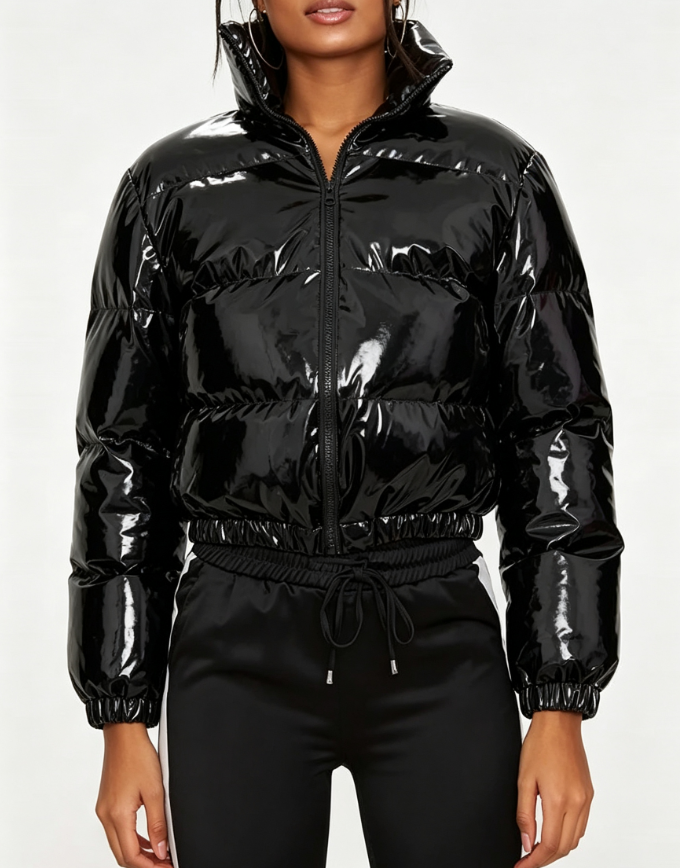
Two jackets may contain the same total amount of fill yet look and feel very different. Distribution determines whether individual channels, baffles, or quilted cells appear balanced and whether the garment retains the intended silhouette.
The tech pack should show compartment boundaries and identify where fill quantity is controlled. This can be done through a chamber-weight schedule, a compartment fill map, or another agreed record that connects each zone to a target. The chosen method should match the construction. A narrow quilt line, a large horizontal baffle, and a loose synthetic-fill panel do not require the same handling approach.
Ask the factory to identify the weighing point in its process. In practical terms, a buyer needs to know whether fill is weighed before insertion, allocated by chamber, checked after assembly, or controlled through a combination of those steps. The best workflow is the one that is clear enough to repeat and inspect.
Review the garment in more than one position
During sample approval, inspect the puffer jacket flat, on a hanger, and on a fitting form or wearer. Move the fill gently toward the chamber edges and then redistribute it with the hands. This does not prove long-term performance, but it can reveal obvious empty zones, overfilled areas, poorly shaped channels, or fill that collects at one end.
Pay close attention to the shoulder area, sleeve head, collar, hem, and front placket. These areas can become visually uneven because their shapes, seams, and construction layers interrupt the flow of fill.
For oversized or drop-shoulder styles, assess distribution with the intended silhouette in mind. A relaxed body can accommodate a different visual volume from a more fitted jacket, but the result should still look deliberate across the graded size set.
Treat leakage risk as a system issue

Fill leakage is rarely explained by one component alone. It can relate to the fill itself, shell and lining construction, stitch density, seam allowances, needle selection, quilting method, seam finishing, and handling during production.
A buyer should avoid approving leakage resistance based only on a quick visual check of a fresh sample. Instead, review the garment as a system and record the exact materials and construction used in the approved sample.
Inspect seam lines, quilting intersections, needle holes, zipper areas, pocket openings, collar seams, cuff attachments, and any point where the shell is perforated or compressed. Look for visible fibers at the surface, material caught in seams, and fill that escapes when the jacket is flexed or lightly manipulated.
When a concern appears, do not issue a vague instruction such as “improve leakage.” State the observed location, the construction condition, and the corrective action to be sampled. For example, the correction may involve reviewing shell selection, lining selection, stitch construction, needle use, or the order in which a chamber is closed. The manufacturer should then submit a revised sample or construction trial for review.
Leakage-risk notes for the approval file
- Identify every observed leakage point by garment location.
- Photograph the exterior and interior view when useful.
- Record shell, lining, fill, thread, and needle-related details supplied for the sample.
- Specify whether the issue is cosmetic, handling-related, or an approval blocker.
- Require a revised construction reference when a change is made.
- Keep the failed sample or clear photo record with the approved version.
This record is more useful than a broad “pass/fail” note because it preserves the reasoning behind the final approved construction.
Define loft recovery as an approval observation

Loft is the visual and tactile volume of the filled garment. It can be affected by fill construction, fill quantity, compartment geometry, shell tension, packing, and how the garment is handled. Buyers should not turn a subjective impression into an unsupported performance promise.
Instead, define a repeatable sample observation. For example, the team can lay the sample flat after unpacking, allow it to rest under agreed sample-room conditions, inspect its profile, lightly compress selected areas by hand, and observe whether the garment returns to an acceptable visual shape. The approval criterion should be written in plain terms: evenness, intended volume, and absence of visibly collapsed compartments.
The approved sample should show the expected silhouette without aggressive shaking or manual redistribution. If a garment needs repeated manipulation to look balanced, clarify whether the design can accept that behavior. If not, revise the fill plan or construction before bulk approval.
It is also important to distinguish loft approval from warmth claims. A fuller appearance does not by itself establish insulation value, comfort in a particular climate, or suitability for a stated temperature range.
Lock the sample before bulk production
The pre-production sample is the working reference for bulk. Once approved, it should be tied to a signed specification package rather than treated as a standalone garment.
That package should include the approved sample identifier, pattern and graded-size-set revision, bill of materials, fill identity record, compartment map, construction notes, labeling instructions, and approved deviations. If a buyer approves a change by email or message, transfer that decision into the controlled approval file so it is not lost between merchandising, development, and production teams.
JUNSHEEN’s development process can include sampling, size-set fitting, fabric and trim sourcing, and quality inspections. For a filled outerwear program, buyers should use those stages to resolve material and construction decisions before confirming bulk production.
Sample-approval checklist
Use this checklist as an approval record, not merely as an internal reminder.
- Confirm the style, colorway, sample revision, and intended size range.
- Match fill against the retained material reference and written identity description.
- Confirm fill placement across body, sleeves, hood, collar, placket, and pockets.
- Review chamber shape and visual distribution while flat, hung, and worn.
- Check that the intended silhouette is achieved without excessive manual redistribution.
- Inspect quilt lines, seam intersections, zipper areas, pockets, cuffs, and hems for visible fill escape.
- Review shell, lining, trim, and construction references against the approved bill of materials.
- Record corrections with a location, photo where helpful, and required resubmission.
- Approve or reject the sample in writing, including revision number and date.
Build batch traceability into the bulk file

Batch traceability does not need to be elaborate to be useful. It needs to let the buyer and manufacturer identify what was received, what was used, and which production lot used it.
At minimum, ask for an internal record that connects fill material to the style, colorway, production order, receipt date or internal receipt reference, supplier material reference if available, and production batch or line reference. The record should also show the approved sample revision and any authorized substitutions.
This matters when bulk inspection finds uneven compartments or leakage in a particular production group. Without a basic material-to-batch connection, the team may not be able to isolate whether the issue is linked to a fill delivery, a construction change, a particular line, or handling at a specific stage.
Practical bulk-production controls
- Verify that incoming fill is identified against the approved material reference.
- Keep fill materials separated and labeled to reduce mix-ups.
- Use the approved compartment map and fill-control method at the relevant production step.
- Retain first-off or in-line references where the production process allows.
- Inspect filled garments before final closing or packing, according to the agreed process.
- Document any material substitution or construction adjustment before it enters bulk use.
- Keep final inspection notes associated with the applicable production batch.
A buyer does not need to prescribe every factory operation. The buyer does need enough visibility to confirm that the approved fill identity and construction have not changed without authorization.
RFQ questions that expose missing fill details
When requesting a quotation or development review, include fill questions early. They reduce the risk of comparing suppliers on an incomplete brief.
- What fill identity and physical reference will be used for the sample?
- How will fill placement be shown and controlled by compartment?
- Which garment areas are most susceptible to uneven distribution in this construction?
- What shell and lining choices are proposed for the selected fill and quilting method?
- Where will the team check for visible leakage during sampling and production?
- What sample revision becomes the bulk reference after approval?
- What internal records can connect incoming fill to the production order or batch?
- How will material or construction changes be submitted for buyer approval?
Clear answers are more valuable than broad assurances. If a supplier cannot explain how the fill is identified, distributed, checked, and recorded, the program is not ready for a confident bulk approval.
Common red flags before bulk sign-off
Watch for fill descriptions that differ across the quotation, sample comments, and bill of materials. Also pause when the sample has no labeled revision, the approved garment is not retained, or a supplier proposes a material substitution without a revised approval sample.
Other warning signs include unexplained differences between chambers, visible fill at sewing points, vague notes about “more filling,” and no clear link between the fill reference and the production order. None of these observations automatically proves a defect, but each deserves clarification before bulk production begins.
FAQ
Is total jacket weight enough to approve puffer fill?
No. Total garment weight may be a useful reference, but it does not show whether fill is correctly placed across compartments. Review fill identity, placement, chamber distribution, and construction together.
Should a buyer approve down and synthetic fill in the same way?
The control framework is similar: define identity, retain a reference, map placement, inspect distribution, review leakage risk, and keep records. The material description and construction details should reflect the specific fill type.
Can loft recovery be used as a warmth claim?
No. A visual loft-recovery observation is a sample-approval criterion. It should not be presented as proof of insulation performance or suitability for a specified temperature.
What should happen if bulk fill differs from the approved sample?
Stop the substitution from becoming an informal production change. Document the difference, assess the effect on appearance and construction, and obtain written approval of a revised material or sample before use.
When should the fill plan be finalized?
Finalize it before bulk production, with the approved sample, material references, compartment map, and construction notes controlled as one package.
Request a filled-outerwear development review
Send your tech pack, reference sample, intended size range, target quantity, and any fill or chamber requirements to JUNSHEEN. A useful inquiry should also identify whether the style is a quilted jacket, sewn-through puffer, baffle construction, vest, or another filled outerwear format, so sampling can focus on the right approval risks.
Sources
No external sources were used. This article provides non-performance manufacturing guidance based on the supplied brand profile and the approval practices described in the brief.